 Double Ape
Websites, forms and apps often accept only certain formats, typically JPG, or PDF for documents. Here's which format to choose, what your phone can already do, and how to convert photos step by step.
Which format should you choose?
- JPG: works everywhere, with small files. The best choice for uploading photos to websites and forms.
- PNG: lossless and supports transparency. Good for screenshots, graphics and text. Photos saved as PNG get much bigger.
- WEBP: smaller files than JPG at similar quality, and supports transparency. Widely used on the web, but some older apps and sites don't accept it.
- PDF: for documents, for example several photos of pages sent as one file.
- HEIC (HEIF): the space-saving format some phones use for camera photos. Not every website or app accepts it, which is the most common reason people need to convert a photo to JPG.
What your phone can do without an app
- Samsung, new photos as JPG: open the Camera, then SettingsAdvanced picture options and turn off High efficiency pictures. New photos are saved as JPG; existing HEIC photos aren't converted. On recent models the setting is under SettingsPhotosPhoto format.
- Samsung, screenshot format: SettingsAdvanced featuresScreenshots and screen recorderScreenshot format, JPG or PNG. It applies to new screenshots only.
- Sharing HEIC photos: Xiaomi's Gallery can convert HEIF photos to JPEG before sharing, and some versions of Samsung Gallery have a similar setting. The original stays HEIC, and the option isn't available on every version.
- Photos to PDF: in gallery apps that offer Print, open a photo, tap Print and choose Save as PDF as the printer. The menu names vary between apps.
- Pixel: the camera saves photos as JPG, so there's usually nothing to convert.
Online converters can convert almost any format in a browser. Most upload your photos to their server and limit file sizes or conversions on free plans; a few, such as Squoosh, convert inside the browser without uploading.
Convert photos with Convert Image
Image Converter JPG PNG PDF converts photos to JPG, PNG, WEBP or PDF on your phone: nothing is uploaded. Converting is free, with ads, with no limit on the number of photos.
Convert images to JPG, JPEG, PNG, WEBP or PDF in seconds - private & offline
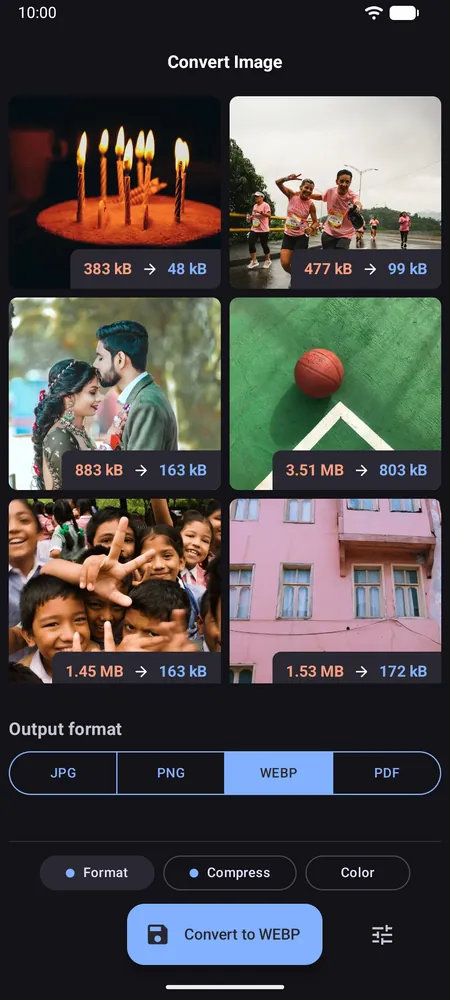
- Pick your photos. Open the app and tap Select images, or share photos to it from your gallery. You can select many at once.
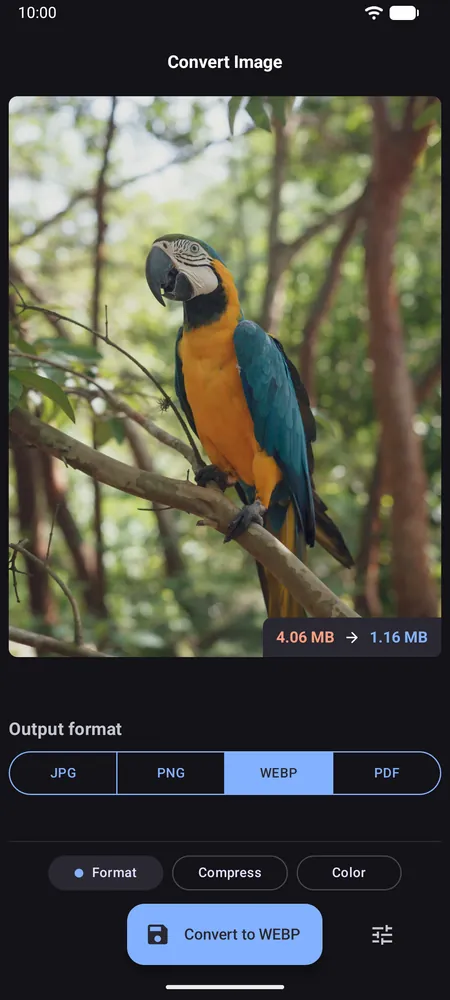
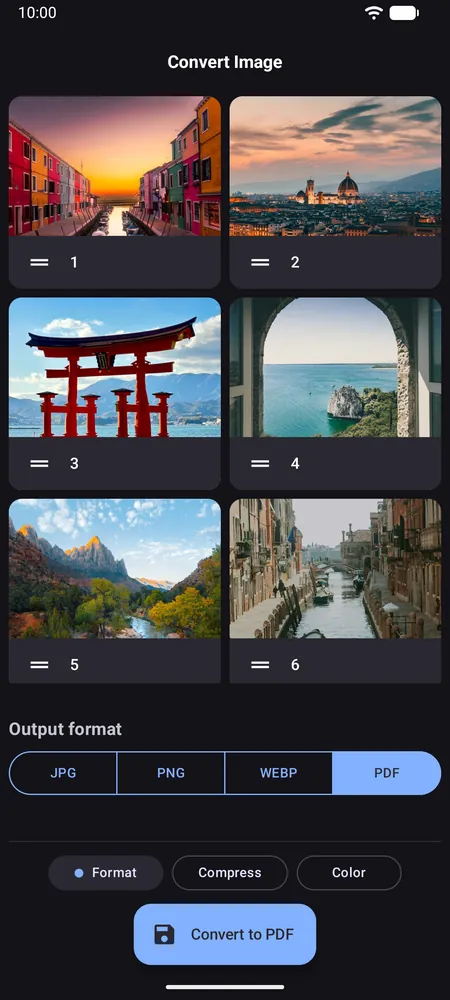
- Choose the format. On the Format tab, pick JPG, PNG, WEBP or PDF under Output format. Each photo shows its size before and after (not for PDF).
- Make files smaller (optional). On the Compress tab, the Compression amount slider lowers the size. For JPG and WEBP, any value above 0% also halves the resolution unless you turn on Keep resolution. For PNG, the slider only reduces the resolution. For PDF, it lowers the quality of the photos inside the PDF.
- Tap the convert button, for example Convert to JPG. Each photo is saved as a new copy; your originals stay as they are.
Where to find the converted files
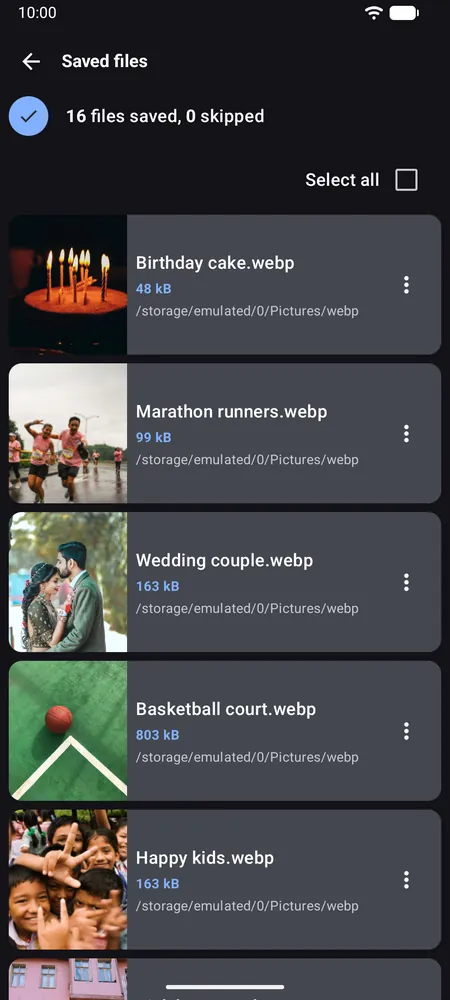
Photos go to Picturesjpg images, Picturespng images or Pictureswebp images, with the same names and the new extension (a number is added if a file with that name already exists), so they appear in your gallery. On the results screen you can open, share or delete each file. On Android 11 and newer, Replace swaps the original for the converted file, after Android asks you to confirm.
Turn several photos into one PDF
Choose PDF, then drag the numbered thumbnails into the order you want and tap Convert to PDF. You get one PDF with one page per photo, saved in Downloadpdf files. From the results screen you can also print it.
Good to know
- JPG and WEBP are always compressed a little, even at 0%. PNG is lossless, but converting a JPG to PNG doesn't bring back lost detail and makes the file bigger.
- Very large photos may be scaled down. For JPG, WEBP and PNG, a photo whose longest side is more than twice your screen's longest side is reduced to that size unless Keep resolution is on (the switch is shown for JPG and WEBP). In a PDF, each photo is scaled to fit its page.
- Transparency: JPG doesn't support it, and the app also fills transparent areas in PDFs, so they become white. You can pick another color on the Color tab, which also has a Black and white option.
- Photo details are removed by default. The date, location and camera information aren't copied unless you turn on Keep metadata in the settings.
- Formats you can open: JPG, PNG, WEBP, BMP, GIF and most formats your phone can read. HEIC needs Android 9 or newer and a phone that can decode the file, an animated GIF becomes a still image, and TIFF isn't supported. The app can't save as HEIC, and it can't turn a PDF back into images.
- What's free: all four formats, compression, color options, batches and PDF creation. Premium, or a short ad, unlocks keeping metadata and renaming or moving the saved files (moving needs Android 11 or newer).
Frequently asked questions
How do I change a HEIC photo to JPG on Android?
Pick the HEIC photo in a converter app, choose JPG and save. To stop new photos being HEIC on a Samsung phone, turn off High efficiency pictures in the camera settings.
How do I make a JPG on my phone?
Most phone cameras already save photos as JPG. If yours saves HEIC, change the camera setting, or convert the photos you already have with a converter app.
Can I turn several photos into one PDF?
Yes. Convert Image creates one PDF from many photos, in the order you choose. Some gallery apps can also print several selected photos to one PDF.
Does converting change the original photo?
No. The converted files are new copies. On Android 11 and newer you can choose to replace the originals from the results screen.